Digitalization and Forestry

Virtual forests, digital twins, or laser scanning – the successful application of digital technologies in forestry is intended not only to generally strengthen competitiveness but also, in connection with climate-adapted forest management, to provide important impulses for increasing energy and cost efficiency and to contribute to resource conservation.
The wood value chain stretches from primary forest production through timber harvesting and transport to the wood-processing and manufacturing industry. Digital technologies are already being applied in the operational processes of the latter. The added value created in this way ensures business viability and provides medium- and long-term location and competitive advantages. Notable digital applications include, for example, rigorous data management from forest to industry, early detection systems for damaged wood in the industry, and computer vision for roundwood sorting. By combining innovation and digitalization in forestry and the wood industry, the entire timber supply chain benefits.
Structural indicators highlight the sector’s economic importance: with approximately 300,000 people employed in the timber supply/value chain, forestry and the wood industry form a backbone of Austria’s economic performance and, after tourism, are the country’s second-largest source of foreign exchange.
Objectives
The Ministry of Forestry pursues and supports a broad approach and takes a very open stance toward the diverse ideas and directions of digitalization in forestry. There is clearly still great potential in forestry to optimize processes for forest operators all the way to timber buyers through digital solutions. However, the implementation of digital projects is hindered by high workloads in core business operations, high costs associated with introducing new products, lack of contact points for initiating digital projects, and insufficient knowledge transfer.
Key focus areas include economic and ecological aspects, the ongoing development of the geodata platform WALDATLAS, digital forest inventories, damage diagnostics and pest prevention, the diverse use of laser scanners for different purposes, data management along the wood value chain including storage management, digital methods for timber acceptance, digitized quantification and qualification of timber, as well as the optimization of business processes, marketing, and sales.
The WALDATLAS – The Geodata Platform for Forests
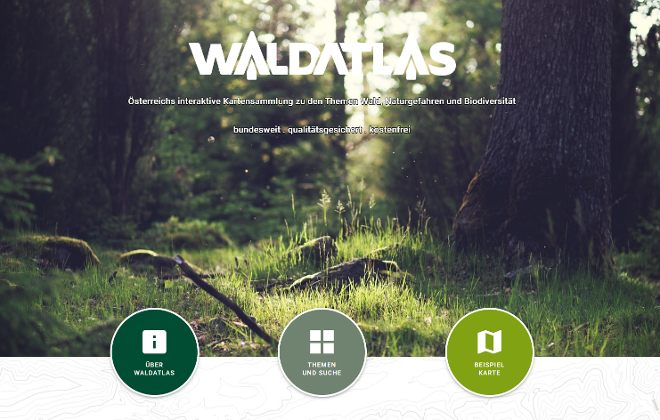
As part of the federal government’s digitalization initiative, the urgent need for an integrated, uniform, and central Austrian geodata platform for forests was recognized. The Ministry of Forestry is establishing the WALDATLAS as a nationwide access point to free geodata on forests, natural hazards, and biodiversity.
What We Are Working On
In addition to projects initiated through the Ministry of Forestry’s internal call for digitalization projects, projects have also been submitted to DaFNE. Furthermore, digitalization projects will be implemented through a call based on the Forest Fund Act.
- Forest 4.0 – Digitalization and Data Management for Small and Medium-Sized Enterprises along the Wood Supply Chain
The aim is to launch a digitalization initiative for Austrian SMEs along the timber supply chain and to provide data management. Innovative programs are designed to bring SMEs up to the latest technological standards and help them work more sustainably and efficiently. Additionally, prototype development projects create and test new technologies. Using these technologies and applications, Austria’s timber supply chain will be better equipped to meet new requirements driven by climate change, and timber as a raw material will see more intensive and broader applications. - Early Detection of Bark Beetle Infestation via Remote Sensing as a Tool in Integrated Bark Beetle Management
The objectives include:- Designing a terrestrial validation concept to evaluate the accuracy of remote sensing detections,
- Deriving a binding, scientifically validated detection rate in the field, particularly for early infestation stages,
- Identifying the most suitable remote sensing technology for each forest owner category, and
- Identifying potential barriers for users and deriving support measures to overcome them.
- Testing Alternative Open Source Software on Client Level in the Open Source Lab of BFW
The Open Source Lab project aims to test alternative software products from open source providers at the client level regarding their suitability for daily operations, GDPR compliance, and economic aspects. The overall goal is to create practical, fully functional workstations using alternative software - or to determine where alternative software may not yet be sufficient. - AI-Based (Protected) Forest Monitoring for Automated and Simplified Forest Inventories Including Practical Planning Options for Forest Owners
Project activities include digital recording of forest structure parameters in protected forests using airborne sensor platforms, obtaining key information on timber stock and forest structure through analysis of remotely sensed image and terrain data, and fully automated calculation and visualization of forest structure parameters with data interpretation to optimize protected forest categorization. Other goals include developing practical data management for data security and exchange among forest owners, managers, and other stakeholders, deriving essential information for simplified forest inventories, and creating practical map products for forest management. - Forest Inventory with Handheld Laser Scanners
This project introduces a modern digital forest inventory method for practical forestry. High-resolution 3D data is collected using handheld laser scanners and supplemented with automated software routines and AI methods. Novel structural metrics are derived from the laser scans, allowing large-scale quantification of canopy closure, layering, regeneration, and deadwood on sample plots. This method provides forestry with essential information for hazard management in protected forests and for biomass and carbon stock accounting. Additional benefits arise for public administration and conservation through detailed data on species and structural diversity. - Digitalization of the Austrian Forest Inventory with Terrestrial Laser Scanning
For sample plots of the Austrian Forest Inventory and permanent experimental plots, high-resolution digital twins are created using terrestrial laser scanning (TLS). Parameters typically measured manually, such as tree position, diameter, height, and crown base, are automatically extracted from point clouds. By capturing multiple tree diameters from base to height, total above-ground biomass and stem quality can be accurately measured and tracked in follow-up assessments. The number of trees measured per plot is greatly increased compared to conventional methods, significantly improving the accuracy of above-ground biomass estimates. The newly available data on tree position, height, crown volume, and crown projection area for all measured trees, including competing neighbors, enables improved individual tree-based forest growth simulations and growth and vitality forecasts under different climate and management scenarios, supporting optimal future tree species selection. The digitalization of ÖWI points also allows quantitative comparison of methods (laser scanning vs. field measurements) and evaluation of biodiversity indicators derived from point clouds, such as heterogeneity metrics or deadwood volumes. - Digitalization in Forestry Technology
From a forestry perspective, the successful application of digital technologies not only strengthens competitiveness but also provides important impulses for energy and cost efficiency and resource conservation when combined with climate-adapted forest management. The project aims to improve cost and energy efficiency as well as reduce environmental impacts in forestry value chains through digitalization in machinery and processes. In sustainable timber production in mountainous regions, the focus is on improving cost efficiency through higher productivity and reduced fuel consumption while protecting forest resources and the environment as an active contribution to climate protection. Increasing mechanization and automation also enhances workplace safety in forestry and offers the opportunity to mitigate labor shortages.